
Most large organisations have strong policies on paper. The problem is the gap between what’s written down and how decisions actually get made every day. Ask the operations head at any large financial institution how approvals work, and you’ll get some version of the same answer: email, WhatsApp, a few phone calls, and someone who knows who to chase. It works, until it doesn’t.
The Real Cost of an Ungoverned Approval Process
When approvals run informally, the damage doesn’t show up as a single incident. It accumulates quietly — delayed disbursements, policy exceptions nobody documented, audit reports that take weeks to compile by hand. Three patterns show up consistently across large enterprises and NBFCs:
- Visibility disappears the moment a request leaves the sender. Once someone hits send, there’s no real-time way of knowing where a request stands. Sitting in an inbox? Escalated? Approved verbally and never logged? The answer is usually: nobody knows, and that uncertainty compounds across hundreds of daily requests.
- Policy exceptions go untracked. Every organisation makes exceptions — to credit policies, operational thresholds, compliance rules. Made for the right reasons, they’re a sign of a functioning business. Undocumented, they become liabilities. A regulator asking for every exception in the last 12 months, with approver names and rationale, should be a one-click exercise. In most organisations, it’s a week-long fire drill.
- Audit readiness is always an emergency. With decisions scattered across email threads and call logs, reconstructing a clean audit trail means someone manually rebuilding the chain of custody — expensive, error-prone, and sometimes impossible.
The issue was never a lack of policy. Every organisation has policies. What’s missing is a system that enforces them automatically and records every decision the moment it’s made.
What a Governed Approval System Actually Looks Like
The concept isn’t complicated. Every approval request — a credit decision, an operational sign-off, a compliance exception — should have a defined path: who it goes to, by when, under what authority, with the full decision documented at the moment it’s made, not reconstructed three months later. That’s the architecture Neo Sentinel is built around: a single platform handling approvals across every function in an enterprise, not just one department or one use case.
- Authority Matrix Engine — automatically routes every request to the right approver based on predefined authority levels. No manual handoffs, no confusion about who owns what.
- Policy Exception Tracking — every exception is captured with the approver’s name, timestamp, and rationale. Nothing goes undocumented.
- Audit Trail and Timestamps — a complete chain of custody is built automatically at every step. When an auditor asks for a decision trail, the answer is ready in thirty seconds, not three days.
- Real-Time Dashboard — leadership gets a live view of every approval in motion: what’s pending, what’s escalated, where exceptions are clustering.
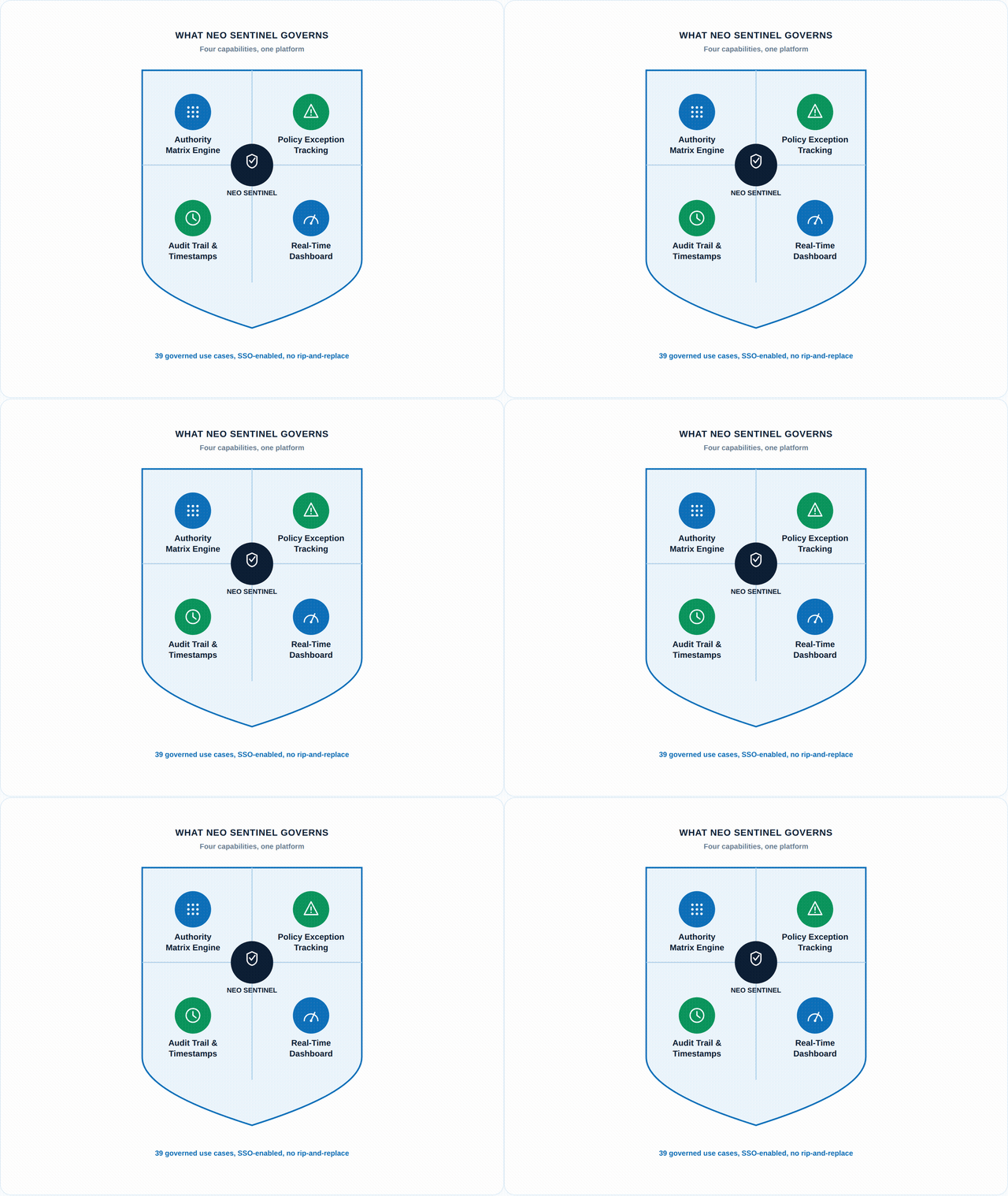
Neo Sentinel covers 39 governed use cases spanning Credit, Risk, Operations, Finance, Legal, Compliance, IT, and Branch functions. The platform is SSO-enabled and integrates with existing enterprise infrastructure, so adoption doesn’t require a rip-and-replace approach.
From Theory to Production: What Happened at a Large Financial Institution
One of India’s leading financial institutions came to us with a familiar set of problems. Operating across 1,000+ offices with 25,000 employees, offering loans, insurance, and investment products, their approval process ran almost entirely on manual effort — and at that scale, the friction was significant. Multi-level approvals took far longer than they should, visibility into request status was poor, and inconsistent audit logs created a compliance risk leadership knew about but hadn’t been able to solve systematically.
We deployed Neo Sentinel across the organisation. Within three months, the platform had processed over 52,000 requests, onboarded more than 17,000 employees, unified 157 departments onto a single system, and reached 300+ daily active users from week one.
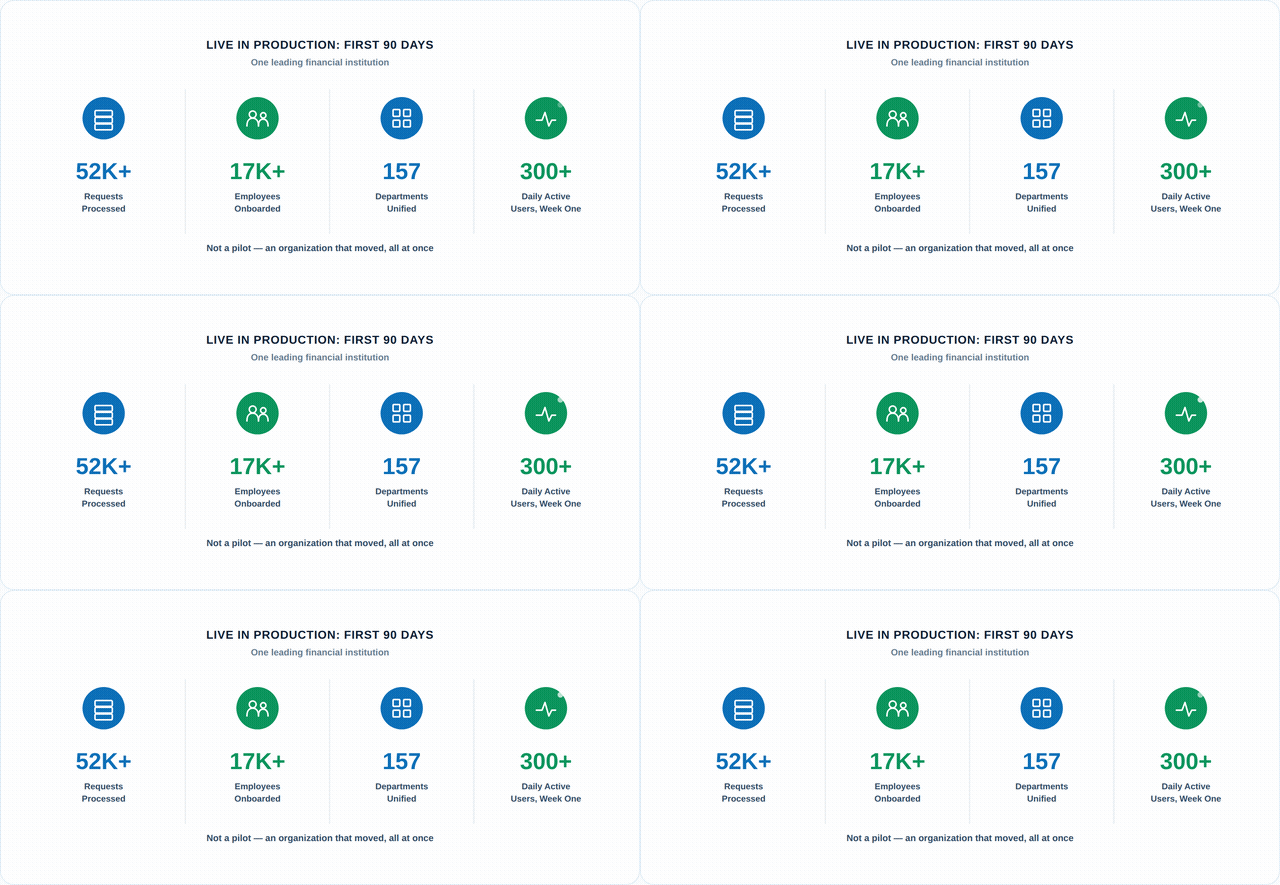
The adoption numbers matter as much as the volume. Seventeen thousand employees across 157 departments using a single platform, consistently, within 90 days of go-live — that’s not a pilot, that’s an organisation that recognised the value immediately and moved with it. What changed wasn’t that people started working harder. The process changed: requests moved automatically to the right approver, SLAs triggered escalations without anyone chasing, every exception was captured the moment it was granted, and when leadership or compliance asked for a report, the data was already there — structured, timestamped, and complete.
The Missing Layer in Most Digital Transformation Programmes
Here’s an observation worth sitting with: most large organisations have invested meaningfully in digital transformation — new apps, data infrastructure, process automation. And yet, ask them how an internal approval actually gets made — a credit sanction, a compliance exception, an operational threshold breach — and the answer is almost always email and WhatsApp. Digital transformation tends to prioritise what’s visible: customer experience, dashboards, reporting. The internal operating layer, where decisions are actually made and authority is exercised, gets deferred. It’s unglamorous work. But it’s where the operational and compliance risk lives. An NBFC or large financial institution running tens of thousands of employees cannot sustain an informal decision-making layer as it scales — the volume is too high, the regulatory stakes too significant, and the cost of a governance gap, when it surfaces, too real.
Where This Fits in 2026: Governance Is Becoming the Bottleneck, Not the Afterthought
The pressure to formalize this layer is no longer theoretical. The average cost of non-compliance across organisations now exceeds $14 million, and penalty regimes like GDPR (up to 4% of global annual revenue) make an undocumented exception trail a board-level risk, not just an operational inconvenience. At the same time, the workflow automation market itself is projected to reach roughly $26–$28 billion in 2026, which reflects how many enterprises are actively replacing informal, email-driven processes with governed systems.
There’s a second pressure building alongside this: as organisations adopt more AI and agentic automation, the governance question gets harder, not easier. Recent industry research finds 84% of organisations cite business risk from inadequate AI controls, 80% point to transparency concerns about automated decision-making, and 66% cite regulatory or compliance concerns directly — even as 71% of organisations now use generative AI in at least one business function. A platform like Neo Sentinel — built around a defined authority matrix, mandatory rationale capture, and an automatic audit trail — is exactly the kind of governed decision layer that makes it possible to introduce more automation, including AI-assisted approvals, without losing the accountability trail regulators and boards are increasingly going to demand.
The Takeaway
The issue was never a lack of policy — it was the absence of a system that enforced it and recorded every decision the moment it happened. As approval volumes grow and regulatory scrutiny tightens, the informal machinery of email, calls, and WhatsApp stops being a workaround and starts being a liability. A governed platform doesn’t just make audits faster; it changes what an organisation can say with confidence about every decision it has ever made.
Join The Conversation
Share your perspective. Comments are moderated before they appear.