
Every enterprise Java codebase eventually faces the same choice: hand-wire the plumbing — object creation, security checks, database access, request routing — for every single feature, or let a framework handle the repetitive parts so the team can focus on the business logic that actually differentiates the product. A framework is pre-written, tested structure: it decides how the pieces of an application fit together and calls your code at the right moments, rather than your code calling it. Spring Boot is the framework most Java teams reach for to do this, and in 2026 it’s paired increasingly often with Spring AI to bring the same conventions to LLM-powered features.
Why Teams Reach for a Framework Instead of Writing It From Scratch
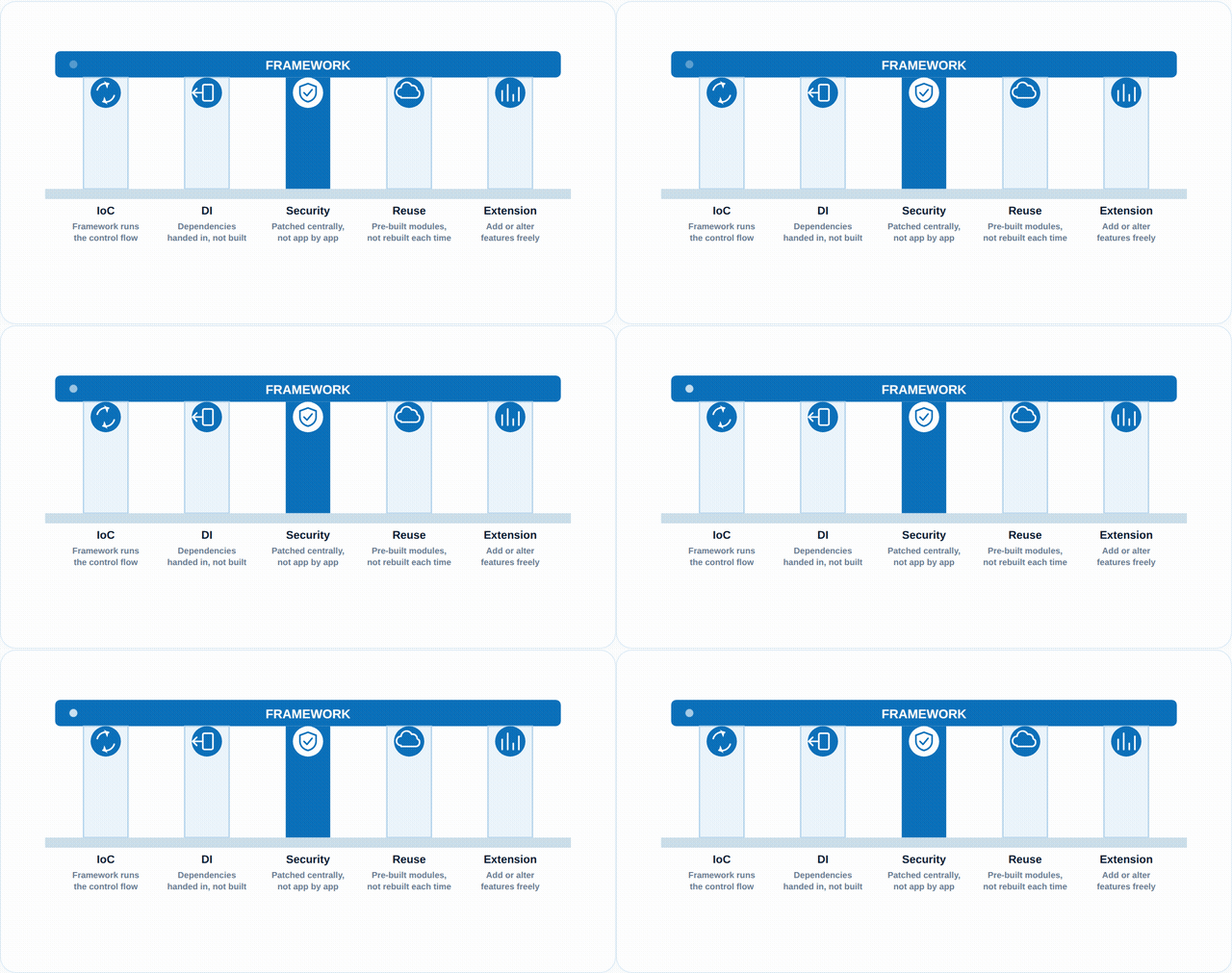
A framework earns its place in a codebase by solving five recurring problems at once:
- Inversion of Control (IoC): the framework runs the control flow. Instead of your code creating and wiring up its own objects, the framework creates them and hands your code what it needs, in the order it needs them.
- Dependency Injection (DI): the specific technique Spring uses for IoC. A class declares what it depends on — a repository, a service, a config value — and Spring constructs and hands in (“injects”) that dependency, rather than the class building it itself.
- Security: authentication, authorization, and common vulnerability protections are handled by framework-level, well-tested code that gets patched centrally, instead of being reimplemented and re-audited in every application.
- Reuse: starters, auto-configuration, and a large ecosystem of pre-built modules mean common needs — talking to a database, exposing a REST endpoint, validating input — don’t get rebuilt from first principles each time.
- Extension: the framework is built to be added to. Auto-configuration can be overridden, and new behavior can be plugged in through well-defined extension points, without forking or patching the framework itself.
Spring MVC: The Pattern Spring Boot Builds On
Spring Boot sits on top of Spring MVC, which implements the Model-View-Controller pattern for web applications: the Model holds the application’s data, the View renders what the user (or API client) sees, and the Controller sits between them, handling incoming requests and deciding what happens next. Every request enters through a single Front Controller — Spring’s DispatcherServlet — which routes it to the right controller method, rather than each endpoint handling its own routing logic independently. This centralizes request handling, which is what makes the request-flow architecture described further down possible.
Spring Boot: Convention Over Configuration
Spring itself is powerful but historically required substantial XML or Java configuration to wire up. Spring Boot’s contribution is auto-configuration: it inspects what’s on the classpath — a database driver, a web starter — and configures sensible defaults automatically, so a working application can start from a handful of annotations rather than pages of setup. Combined with an embedded server (Tomcat, Netty, or similar), a Spring Boot application packages as a single standalone JAR that runs anywhere a JVM does, with no separate application server to install and configure.
Spring Boot’s Layered Architecture
A typical Spring Boot application is organized into four layers, each with one job, running in this order: the Presentation Layer (controllers) handles JSON translation and authentication at the edge of the application; the Business Layer (services) holds business logic, validation, and authorization; the Persistence Layer (repositories, typically via Spring Data JPA) handles storage logic; and the Database Layer is the database itself. Presentation calls Business, Business calls Persistence, Persistence talks to the Database — each layer only knows about the one directly below it, which is what keeps a change to the database schema from rippling all the way up to the controller.
How a Request Actually Flows Through a Spring Boot App
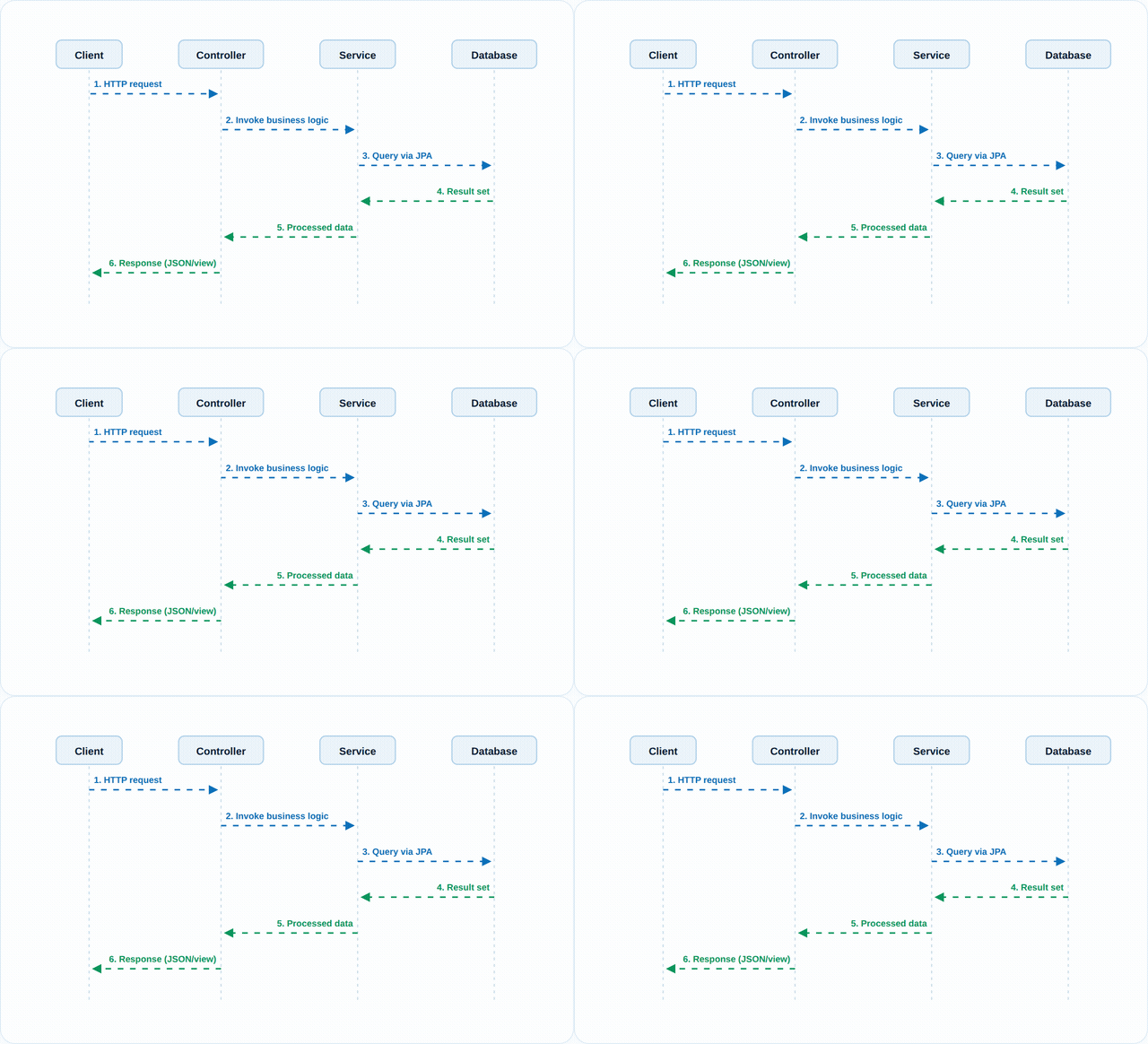
Putting the layers in motion, a single request travels through six steps: the Client sends an HTTP request to the Controller (1); the Controller invokes business logic on the Service (2); the Service queries via JPA against the Database (3); the Database returns a result set to the Service (4); the Service returns processed data back to the Controller (5); and the Controller sends the final response — JSON or a rendered view — back to the Client (6). Everything downstream of step 1 is invisible to the client; all it sees is a request going out and a response coming back.
Where This Fits in 2026: Spring Boot 4 and Spring AI
Spring Boot 4 (and the 4.1 line) restructures how the framework itself is packaged: the old monolithic spring-boot-autoconfigure artifact is being broken into smaller, technology-focused modules and starters, which trims both startup overhead and JAR size by pulling in only what an application actually uses. Teams on Spring Boot 3.5.x get a spring-boot-starter-classic bridge as a migration step before moving fully to 4.x. Spring Boot 4 also leans into Java 25’s virtual threads, which let I/O-bound code stay in a simple, imperative style — reading as a normal blocking call — while scaling the way reactive code does, reducing how often teams need to reach for reactive programming just for concurrency. For serverless and autoscaling deployments, Spring Boot 4 pairs with GraalVM native image compilation to start in milliseconds instead of the seconds a JVM cold start typically takes.
The more visible 2026 shift is Spring AI, which reached 1.0 (general availability) in May 2025. It applies Spring’s own conventions — model-agnostic abstractions, auto-configuration, starter dependencies — to building on top of large language models. A team adds a starter and an API key, then calls the model through an injected ChatClient or ChatModel bean, the same dependency-injection pattern used for a database or a REST client; swapping AI providers is a configuration change, not a rewrite. Spring AI also auto-configures retrieval-augmented generation (document ingestion and chunking into vector stores like PostgreSQL/pgvector, MongoDB Atlas, Pinecone, or Qdrant), tool calling through @Tool-annotated, Spring-managed methods, two-way integration with external AI systems via the Model Context Protocol (MCP), and built-in conversation memory with configurable retention. For a Spring Boot team, adding an AI feature increasingly looks like adding any other Spring dependency, not standing up a separate AI stack.
The Takeaway
A Java framework’s value isn’t magic — it’s IoC, DI, security, reuse, and extension handled once, well, instead of rebuilt per project. Spring Boot packages those five pillars behind auto-configuration and a standalone, deployable JAR built on Spring MVC’s Model-View-Controller pattern. In 2026, that same foundation is what lets Spring Boot 4’s lighter modules and virtual threads, and Spring AI’s model-agnostic starters, extend the framework into native-image deployments and LLM-powered features without changing how a Spring team already works.
Join The Conversation
Share your perspective. Comments are moderated before they appear.